Trump Approves Cross-Border Permit for Bridger Pipeline
News
May 4, 2026
Share:
Trump Approves Cross-Border Permit for Bridger Pipeline
Story from www.billingsgazette.com
President Donald Trump approved a cross-border permit last week, allowing Bridger Pipeline to build its 647-mile expansion across the Canadian border to Phillips County down through Eastern Montana to Guernsey, Wyoming.
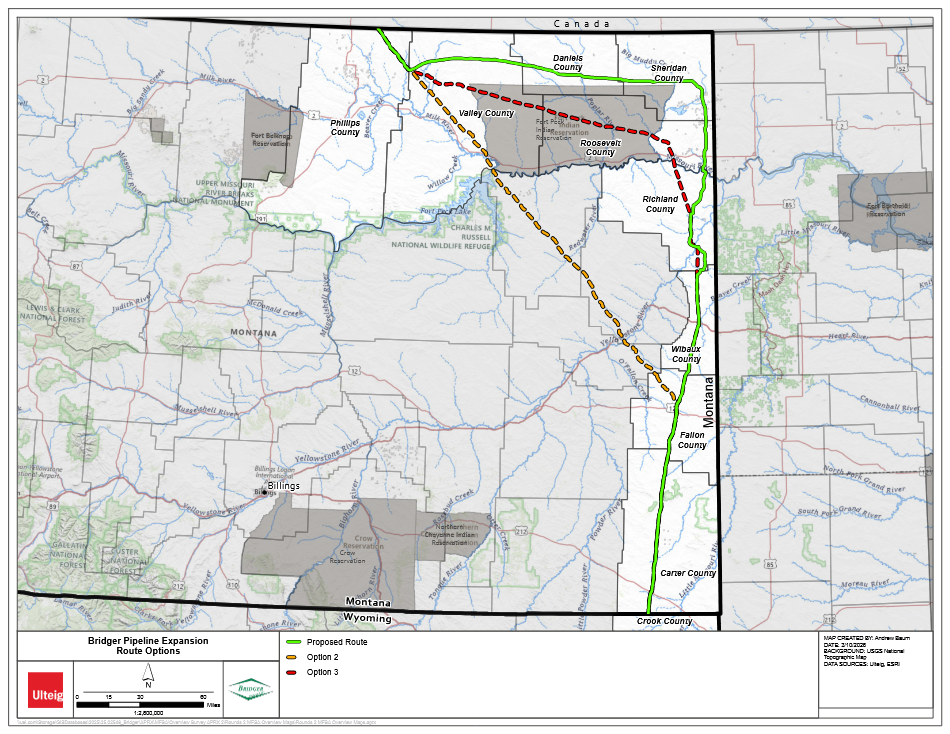
A document associated with the company's March application shows proposed routes for the Bridger Pipeline expansion coming from Canada.
A presidential permit is a crucial element in developing a pipeline from Canada into the United States. The past undeveloped Keystone XL pipeline ultimately faltered once President Joe Biden revoked its cross-border permit after Trump issued the permit in his first term. President Barack Obama had first rejected the permit application in 2015 amid environmental concerns.
The Bridger Pipeline expansion would transfer oil from a currently unspecified location in Canada. It’s the same diameter as the past Keystone pipeline. It would be capable of carrying 1.13 million barrels per day, though it is expected to carry about half of that based on market demand. There are at least 31 cross-border oil pipelines from Canada to the United States.
Work on the currently proposed pipeline will cost Bridger nearly $2 billion for the Montana portion alone.
While preliminary project documents indicate Wyoming-based Bridger Pipeline considered less lengthy and likely more cost-effective routes, those options would likely have had a more arduous permitting process.
Portions of the routes went through reservation land and or were adjacent to Charles M. Russell National Wildlife Refuge. The current route is mostly on private land and existing pipeline corridors, with 10% on state land and another 10% on federal land.
The Keystone pipeline was meant to transfer controversial oil sands crude from Canada into the United States. The product was considered by environmentalists and the Biden administration to be more harmful to the environment given the more arduous processing methods it requires. Yellowstone Public Radio reported Wednesday that the project would transfer oil sands, also known as tar sands, before being piped down south to refineries either in Cushing, Oklahoma or to the Gulf Coast.
Environmental groups and the American Indian Movement have referenced Bridger’s past involvement in Montana when one of its buried pipelines ruptured in 2015 under the Yellowstone River, spilling oil near Glendive, alongside more recent incidents in North Dakota and Wyoming.
The company has said its detection systems for oil spills have improved since that Glendive incident. The pipeline is reportedly planned to be buried 30 to 40 feet below most rivers to prevent such an accident from reoccurring.
Bridger Pipeline has previously estimated that construction would begin in July 2027. In its initial siting application, it estimated that construction would take about 12 to 18 months, or around January 2029 at the latest.