National Average Gas Price Moves Higher, Inches Toward $4 per Gallon
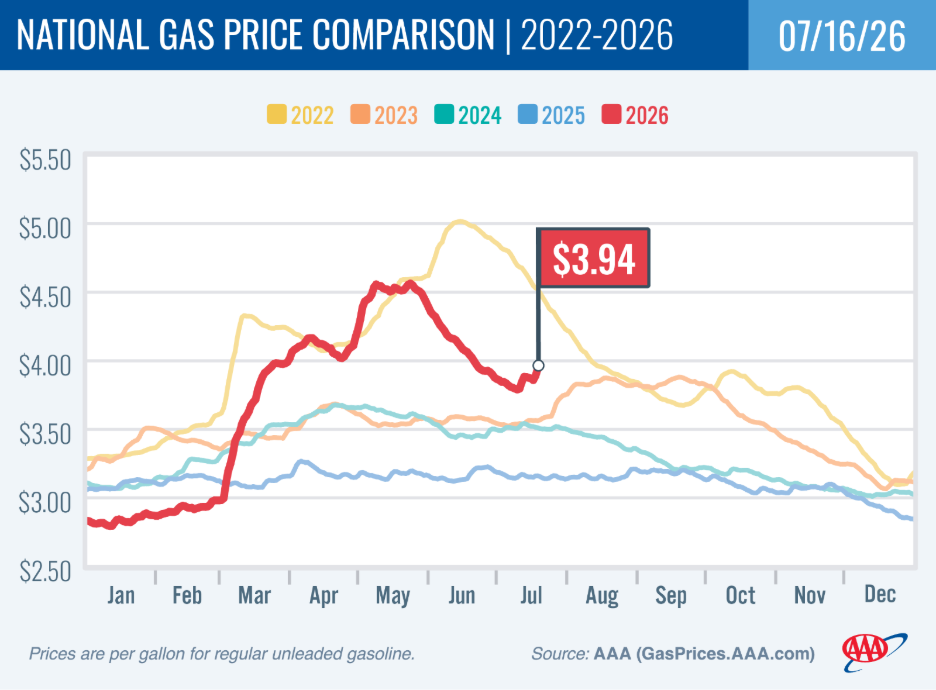
WASHINGTON, DC (July 16, 2026) – The national average for a gallon of regular gasoline went up 10 cents since last week to $3.94. Instability along the Strait of Hormuz is contributing to the increase at the pump and pushing crude oil prices toward $80 per barrel. Most states are still averaging less than $4 per gallon. Earlier this year, the national average remained in the $4 range all of April and May and most of June. Last time the national average was $4 or above was on June 17 when it was $4.02.
Today’s National Average: $3.943
One Week Ago: $3.846
One Month Ago: $4.044
One Year Ago: $3.160
According to new data from the Energy Information Administration (EIA), gasoline demand remained flat last week at 8.84 million. Total domestic gasoline supply decreased from 212.1 million barrels to 210.5 million. Gasoline production decreased last week, averaging 9.6 million barrels per day.
Oil Market Dynamics
At the close of Wednesday’s formal trading session, WTI rose 26 cents to settle at $79.60 a barrel. The EIA reports that crude oil inventories decreased by 1.7 million barrels from the previous week. At 409.7 million barrels, U.S. crude oil inventories are about 6% below the five-year average for this time of year.
State Stats
Gas
The nation’s top 10 most expensive gasoline markets are Hawaii ($5.43), California ($5.40), Washington ($4.98), Alaska ($4.67), Nevada ($4.55), Oregon ($4.51), Illinois ($4.12), Arizona ($4.12), New York ($4.10), and Michigan ($4.07).
The nation’s top 10 least expensive gasoline markets are Indiana ($3.31), Mississippi ($3.49), Louisiana ($3.53), Texas ($3.54), Oklahoma ($3.55), Tennessee ($3.55), Arkansas ($3.55), Kentucky ($3.56), Alabama ($3.58), and Missouri ($3.60).